Elaha
The standard Aramaic word for “God.” Used as the general equivalent for the Hebrew Elohim, or to refer to the divine being in a broader sense.
Seek and You Shall Find
Scripture, wisdom, and truth - choose how you'd like to begin.
findyahweh.com - Seek and You Shall Find
Who is Yahweh? Discover the sacred name YHWH, Scripture, and the path to the living God.
|
"You will seek Me and find Me when you search for Me with all your heart."- Jeremiah 29:13
שְׁמַע יִשְׂרָאֵל יְהוָה אֱלֹהֵינוּ יְהוָה אֶחָד
"Hear, O Israel: Yahweh our God, Yahweh is one." - The Shema, spoken since the days of Moses

Yahweh - rendered in Hebrew as יהוה (YHWH) - is the personal, covenant name of the God of Israel. It appears over 6,800 times in the Old Testament. This is not a distant force or an abstract principle. This is the living God who entered history, spoke to Moses from a burning bush, and declared:
"I AM WHO I AM." Exodus 3:14
The name Yahweh reveals God as self-existent, eternal, and utterly faithful. He is the Creator of heaven and earth - who formed the stars with His fingers and breathed life into humanity. He is holy, set apart from all creation, yet He draws near to those who call upon Him in truth.
Throughout Scripture, Yahweh is revealed as a God of covenant love (hesed in Hebrew) - steadfast, merciful, and slow to anger. He chose Abraham and promised that through his descendants all nations would be blessed. He delivered Israel from slavery in Egypt with a mighty hand. He gave the Law at Sinai not to burden His people, but to show them how to live in harmony with His holy character.
Before the mountains were born, before the world began - Yahweh is. He has no beginning and no end.
All authority in heaven and on earth belongs to Him. He works all things according to the counsel of His will.
God is love. His compassion never fails. He desires that none should perish, but that all should come to repentance.
Separate from sin, pure in essence. Yet in His holiness He provided a way for sinners to be reconciled to Him.
In Aramaic - the language Jesus spoke and the tongue of the ancient Targums and the Peshitta - the name Yahweh (the Hebrew Tetragrammaton יהוה / YHWH) does not have a direct exact spelling, as the proper name is strictly Hebrew. Instead, Aramaic texts substitute or translate it using these primary terms:
The standard Aramaic word for “God.” Used as the general equivalent for the Hebrew Elohim, or to refer to the divine being in a broader sense.
Literally “Lord God” or “The Lord.” A widely used Aramaic construct that serves as the direct equivalent to the Hebrew title Adonai - spoken in place of the sacred name YHWH out of reverence.
These renderings appear throughout the ancient Targums (Aramaic paraphrases of Hebrew Scripture) and the Peshitta (the Syriac Bible), preserving reverence for the divine name while making Scripture accessible to Aramaic-speaking peoples across the Near East - including the world in which Christ walked.
Hebrew is read right to left. The Name is written יהוה - beginning with the small letter Yod (י) at the right end, then He (ה), Waw (ו), and He (ה). Across languages and centuries, that one Name has been written and spoken in these principal forms:
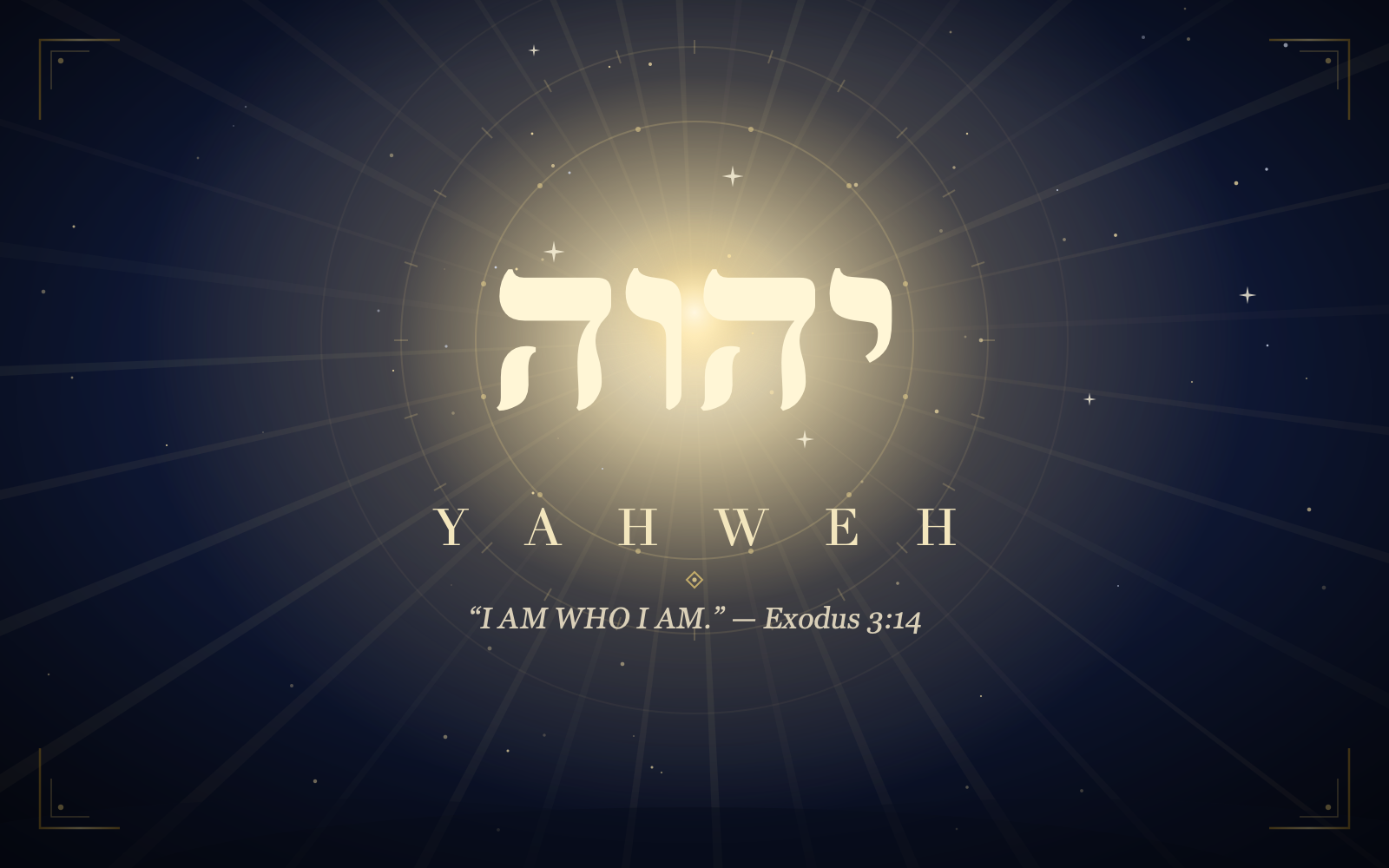
The original four Hebrew consonants - Yod, He, Waw, He - written without vowels, appearing about 6,800 times in the Hebrew Bible. “This is My name forever” (Exodus 3:15).
The standard English transliteration of the four consonants (older works also use JHVH). Scholars vocalize it Yahweh - also spelled Yahveh, or Jahwe in German scholarship, where J sounds like Y.
Hebrew for “My Lord.” Since the days of the Second Temple, readers of Scripture have reverently spoken Adonai aloud wherever the written text bears the sacred Name.
Hebrew for “The Name.” In everyday Jewish speech and writing, HaShem refers to God without uttering the sacred Name itself - an expression drawn from Scripture’s own phrase “the Name” (Leviticus 24:11).
Most English Bibles print LORD in capital letters wherever the Hebrew reads יהוה - following the Adonai tradition. The World English Bible, quoted throughout this site, restores the name Yahweh.
Medieval scribes joined the consonants YHWH with the vowel marks of Adonai - a reading aid, not a name. Read as one word it produced Jehovah, which entered English Bibles in the 1500s. Read the full story.
The oldest surviving Greek copies of the Scriptures (among the Dead Sea Scrolls, 1st century BC) transcribe the Name as Iaō - early witness that the Name was still written out, not yet replaced by a title.
“I am Yahweh. That is My name. I will not give My glory to another” (Isaiah 42:8). However the pen renders it - Hebrew consonants, English capitals, or Greek letters - Scripture presents one living God who bears it. Learn what the Name means, how to pronounce it, and the meaning of each of the four letters.
God created humanity in His own image - male and female - and placed them in a garden of perfect fellowship. But Adam and Eve chose rebellion over obedience, and sin entered the world. Death, suffering, and separation from God became the human condition. Every person since has inherited a fallen nature and stands guilty before a holy God.
Yahweh gave the Law to reveal the depth of human sin and the impossibility of earning salvation by works. The sacrificial system - the blood of bulls and goats - pointed forward to a greater sacrifice. "Without the shedding of blood there is no forgiveness" (Hebrews 9:22). The prophets foretold a Suffering Servant who would bear the sins of many.
In the fullness of time, God Himself entered creation. The Word became flesh and dwelt among us. Jesus of Nazareth - born of a virgin in Bethlehem, raised in Nazareth - lived a sinless life, fully God and fully man. He healed the sick, opened blind eyes, cast out demons, and proclaimed the Kingdom of God with authority no rabbi had ever possessed.
On a Roman cross outside Jerusalem, Jesus bore the wrath of God against sin. He who knew no sin became sin for us. He died, was buried, and on the third day rose from the dead - conquering death itself. Over 500 witnesses saw the risen Lord. The empty tomb stands as the cornerstone of Christian faith.
Salvation is not earned - it is received. "For by grace you have been saved through faith, and that not of yourselves; it is the gift of God, not of works, lest anyone should boast" (Ephesians 2:8-9). Whoever believes in the Lord Jesus Christ shall be saved. Repent of sin. Trust in Christ alone. Be born again by the Spirit of God.
Those who belong to Christ receive eternal life - not merely endless existence, but the very life of God dwelling within. We await the return of the King, the resurrection of the body, a new heaven and new earth, and everlasting fellowship with Yahweh face to face. This is the hope that anchors the soul.
Jesus (Yeshua in Hebrew, meaning "Yahweh saves") is the promised Messiah - the Anointed One foretold by Moses, David, Isaiah, and every prophet who spoke by the Spirit of Yahweh.
He is the Seed of the woman who would crush the serpent's head (Genesis 3:15). He is the Prophet like Moses whom God would raise up (Deuteronomy 18:15). He is the Son of David whose kingdom would never end (2 Samuel 7:12-16). He is Immanuel - "God with us" (Isaiah 7:14). He is the Suffering Servant who bore our griefs and carried our sorrows (Isaiah 53).
The apostles declared Him Lord and Christ after witnessing His resurrection. Thomas fell at His feet and cried, "My Lord and my God!" Peter proclaimed, "There is salvation in no one else, for there is no other name under heaven given among men by which we must be saved."
Today, Jesus sits at the right hand of the Father, interceding for His people. He is the head of the Church, the Good Shepherd who lays down His life for the sheep, the Way, the Truth, and the Life. No one comes to the Father except through Him.
The Bible is the inspired, infallible Word of God - breathed out by the Holy Spirit through human authors across millennia. It is living and active, sharper than any two-edged sword, discerning the thoughts and intentions of the heart.
תַּנַ״ךְ - Tanakh
The Hebrew Scriptures - Torah (Law), Nevi'im (Prophets), and Ketuvim (Writings) - reveal God's creation of the world, His covenant with Israel, the history of redemption, and hundreds of prophecies pointing to the coming Messiah. From Genesis to Malachi, every page whispers His name.
Ἡ Καινὴ Διαθήκη
The Gospels record the life, death, and resurrection of Jesus. Acts tells of the Spirit-empowered Church. The Epistles instruct believers in doctrine and holy living. Revelation unveils the triumph of the Lamb and the glory of the age to come.
"In the beginning was the Word, and the Word was with God, and the Word was God."
John 1:1"All Scripture is breathed out by God and profitable for teaching, for reproof, for correction, and for training in righteousness."
2 Timothy 3:16"Your word is a lamp to my feet and a light to my path."
Psalm 119:105"Heaven and earth will pass away, but my words will never pass away."
Matthew 24:35On Mount Sinai, Yahweh inscribed His eternal moral law on tablets of stone through Moses. These Ten Commandments have governed civilization for three thousand five hundred years. Jesus affirmed them - and summarized all the Law and the Prophets in two supreme commandments of love. Together they form the Twelve Commandments: the complete foundation of righteous living before God.
אָנֹכִי יְהוָה אֱלֹהֶיךָ
"I am Yahweh your God, who brought you out of the land of Egypt, out of the house of slavery."Exodus 20:2 - The voice of God upon the mountain, amid thunder, lightning, and smoke
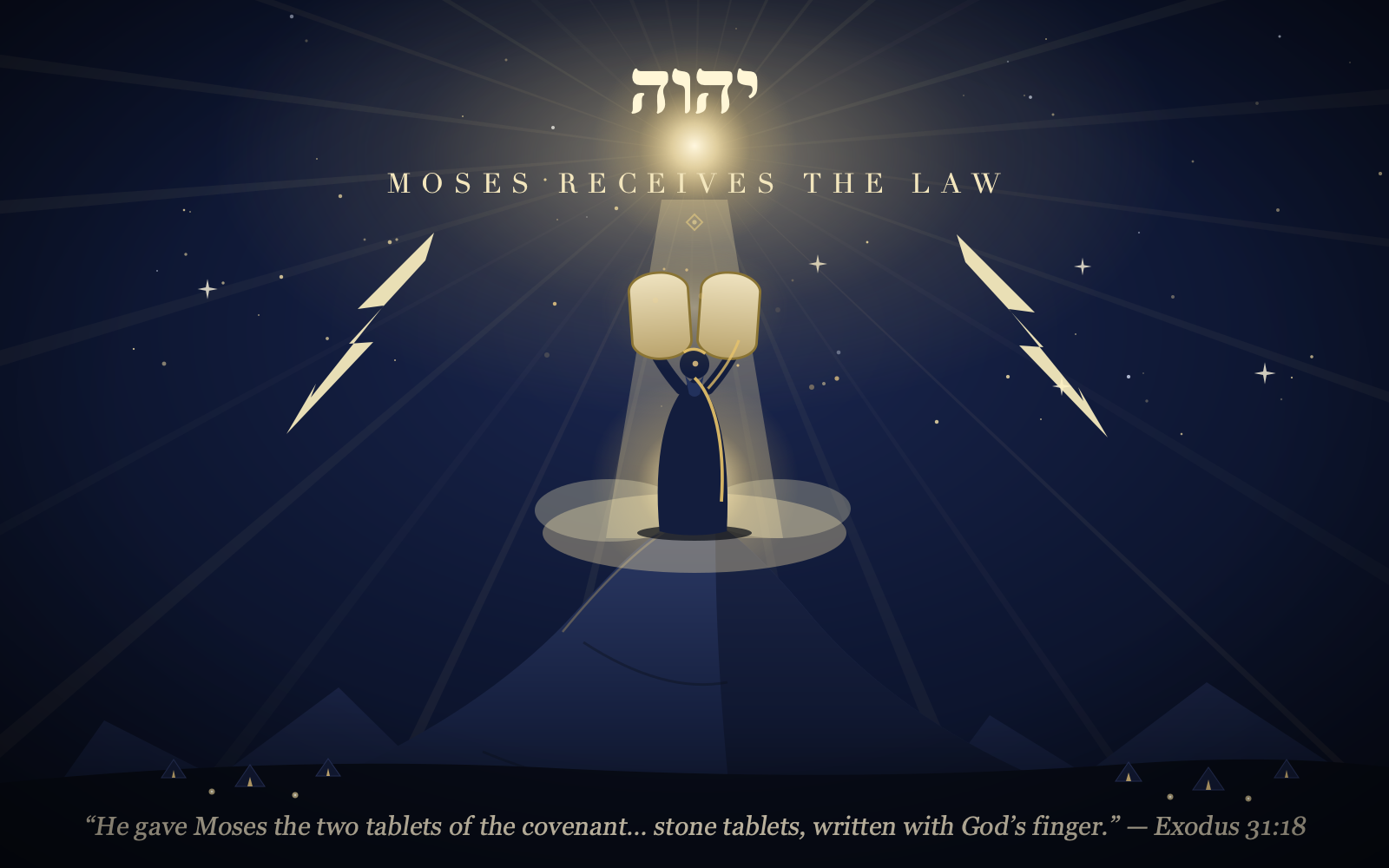
"You shall have no other gods before Me."
Exodus 20:3"You shall not make for yourself a carved image - any likeness of anything in heaven above, or in the earth beneath, or in the water under the earth. You shall not bow down to them nor serve them. For I, Yahweh your God, am a jealous God."
Exodus 20:4-5"You shall not take the name of Yahweh your God in vain, for Yahweh will not hold him guiltless who takes His name in vain."
Exodus 20:7"Remember the Sabbath day, to keep it holy. Six days you shall labor and do all your work, but the seventh day is the Sabbath of Yahweh your God. For in six days Yahweh made the heavens and the earth, the sea, and all that is in them, and rested the seventh day."
Exodus 20:8-11"Honor your father and your mother, that your days may be long upon the land which Yahweh your God is giving you."
Exodus 20:12"You shall not murder."
Exodus 20:13"You shall not commit adultery."
Exodus 20:14"You shall not steal."
Exodus 20:15"You shall not bear false witness against your neighbor."
Exodus 20:16"You shall not covet your neighbor's house; you shall not covet your neighbor's wife, nor his male servant, nor his female servant, nor his ox, nor his donkey, nor anything that is your neighbor's."
Exodus 20:17When asked which commandment was greatest, Jesus answered - summing up the entire Law:
וְאָהַבְתָּ אֵת יְהוָה אֱלֹהֶיךָ
"You shall love Yahweh your God with all your heart, with all your soul, with all your mind, and with all your strength."
Deuteronomy 6:5 - Affirmed by Jesus in Mark 12:30וְאָהַבְתָּ לְרֵעֲךָ כָּמוֹךָ
"You shall love your neighbor as yourself. There is no other commandment greater than these."
Leviticus 19:18 - Affirmed by Jesus in Mark 12:31"On these two commandments hang all the Law and the Prophets." Matthew 22:40
These commandments were not suggestions - they are the eternal moral law of Yahweh, written by the finger of God upon stone (Exodus 31:18). Jesus declared He did not come to abolish the Law but to fulfill it (Matthew 5:17). The apostle John wrote: "For this is the love of God, that we keep His commandments. And His commandments are not burdensome" (1 John 5:3).
Every civilization that built its laws upon these words prospered. Every nation that abandoned them fell. They reveal what holiness looks like - love toward God and love toward humanity. They expose sin, guide the conscience, and point every soul to the Savior who kept them perfectly on our behalf.
Prayer is the breath of the soul - the intimate conversation between a believer and the Creator of the universe. Yahweh invites us to come boldly before His throne of grace. He hears the cry of the righteous. He inclines His ear to the prayers of His children.
Jesus taught His disciples the model prayer - the Lord's Prayer - a pattern of worship, surrender, petition, and trust. When you listen to the worship song playing on this site, you hear this ancient prayer in its original Hebrew - the very language in which Moses received the Law and the prophets spoke.
אָבִינוּ שֶׁבַּשָּׁמַיִם, יִתְקַדֵּשׁ שִׁמְךָ
Our Father in heaven, hallowed be Your name.
Your kingdom come, Your will be done, on earth as it is in heaven.
Give us this day our daily bread.
And forgive us our debts, as we also have forgiven our debtors.
And lead us not into temptation, but deliver us from evil.
For Yours is the kingdom and the power and the glory, forever. Amen.
Worship God for who He is - holy, mighty, loving, faithful. Praise lifts our eyes from earthly troubles to heavenly glory.
Honest acknowledgment of sin before a merciful God. "If we confess our sins, He is faithful and just to forgive us" (1 John 1:9).
Gratitude for every good gift - salvation, provision, relationships, breath itself. In everything give thanks.
Bring your needs, your burdens, your intercessions for others. Cast all your anxiety on Him, because He cares for you.
Faith is trust in God that goes beyond sight. Abraham believed God and it was counted to him as righteousness. Faith is the assurance of things hoped for, the conviction of things not seen. It comes by hearing, and hearing through the word of Christ. Without faith it is impossible to please God.
"Now faith is confidence in what we hope for and assurance about what we do not see."Hebrews 11:1
Christian hope is not wishful thinking - it is a confident expectation anchored in the resurrection of Jesus. We hope for what we do not yet see, with patience. Our citizenship is in heaven. We await a Savior who will transform our lowly bodies to be like His glorious body.
"May the God of hope fill you with all joy and peace as you trust in Him."Romans 15:13
The greatest of these is love. God so loved the world that He gave His only Son. We love because He first loved us. Love is patient and kind. It bears all things, believes all things, hopes all things, endures all things. By this all people will know that you are My disciples - if you have love for one another.
"And now these three remain: faith, hope and love. But the greatest of these is love."1 Corinthians 13:13
Christianity worships one God in three Persons - Father, Son, and Holy Spirit - co-equal, co-eternal, and united in essence. This mystery is not contradiction but the depth of divine reality.
Creator, Sustainer, and Sovereign Lord. The source of all life and the author of salvation.
Jesus Christ - eternally begotten, incarnate, crucified, risen, and reigning at the right hand of the Father.
The Comforter who indwells believers, convicts of sin, regenerates hearts, and empowers for service.
From the burning bush to the empty tomb, from Sinai to the catacombs of Rome - these words have endured for millennia. They are not relics of a dead past. They are living fire, passed hand to hand across generations of saints who sought the same God you seek today.
שְׁמַע יִשְׂרָאֵל יְהוָה אֱלֹהֵינוּ יְהוָה אֶחָד
Hear, O Israel: Yahweh our God, Yahweh is one. Love Yahweh your God with all your heart, with all your soul, and with all your strength. These words, which I am commanding you today, shall be on your heart.Deuteronomy 6:4-6 - The Shema, recited morning and evening for over three thousand years
יִרְאַת יְהוָה רֵאשִׁית דָּעַת
"The fear of Yahweh is the beginning of wisdom, and the knowledge of the Holy One is understanding."Proverbs 9:10
יְהוָה רֹעִי לֹא אֶחְסָר
"Yahweh is my shepherd; I shall not want. He makes me lie down in green pastures. He leads me beside still waters. He restores my soul."Psalm 23:1-3
אָנֹכִי יְהוָה אֱלֹהֶיךָ
"I am Yahweh your God, who brought you out of the land of Egypt, out of the house of slavery."Exodus 20:2 - The opening of the Ten Commandments at Sinai
יָבֵשׁ חָצִיר נָבֵל צִיץ וּדְבַר־אֱלֹהֵינוּ יָקוּם לְעוֹלָם
"The grass withers, the flower fades, but the word of our God will stand forever."Isaiah 40:8
"He has told you, O man, what is good; and what does Yahweh require of you but to do justice, and to love kindness, and to walk humbly with your God?"Micah 6:8
"Remember also your Creator in the days of your youth, before the evil days come and the years draw near of which you will say, 'I have no pleasure in them.'"Ecclesiastes 12:1
"I know that my Redeemer lives, and at the last He will stand upon the earth. And after my skin has been thus destroyed, yet in my flesh I shall see God."Job 19:25-26 - Among the oldest declarations of resurrection hope
"Lord, You have been our dwelling place in all generations. Before the mountains were brought forth, or ever You had formed the earth and the world, from everlasting to everlasting, You are God."Psalm 90:1-2 - A prayer of Moses, the man of God
Those who walked with the apostles, who were martyred in Rome's arenas, who defended the faith against emperors and heresies - their words still burn with holy fire.
"You have made us for Yourself, O Lord, and our heart is restless until it rests in You."Confessions, Book I - The most quoted sentence in Christian literature after Scripture
"Where Jesus Christ is, there is the Catholic Church. He is all and in all. Come together in faith and in the Lord Jesus, who is the seed of David according to the flesh, the Son of Man and Son of God."Letter to the Smyrnaeans - Written en route to martyrdom in Rome
"Let him who has love in Christ keep the commandments of Christ. Who can describe the bond of the love of God? Who is able to express the excellence of its beauty? The height to which love exalts is unspeakable."First Epistle to the Corinthians - One of the earliest Christian documents outside the New Testament
"The glory of God is a living man; and the life of man consists in beholding God. For if the manifestation of God gives life to all who dwell upon the earth, much more does that revelation of the Father which comes through the Word give life to those who see God."Against Heresies, Book IV - Disciple of Polycarp, who knew the Apostle John
"God became man so that man might become partakers of the divine nature. He endured shame that we might share in His glory. He accepted death that we might be made alive."On the Incarnation - The great defender of the Nicene faith
"Prayer is the place of refuge for every worry, a foundation for cheerfulness, a source of constant happiness, a wide sea of joy. If you pray truly, you are a theologian; if you are a theologian, you will pray truly."Homily on Prayer - "Golden Mouth," greatest preacher of the ancient Church
"Eighty and six years have I served Him, and He never did me any injury. How then can I blaspheme my King and my Savior?"Martyrdom of Polycarp - At age 86, burned at the stake for refusing to deny Christ
"We who formerly delighted in fornication now embrace chastity alone. We who valued above all things the acquisition of wealth and possessions, now bring what we have into a common stock and share with every one in need."First Apology - Addressed to the Roman Emperor Antoninus Pius
In the scorching silence of the Egyptian and Syrian wilderness, monks and hermits pursued God with such intensity that kings traveled weeks to hear a single sentence from their lips.
"Go, sit in your cell, and your cell will teach you everything."
"The beginning of evil is the absence of the fear of God."
"A time is coming when people will go mad, and when they see someone who is not mad, they will attack him, saying: 'You are mad, you are not like us.'"
"The soul that loves God rests in Him alone. It has no need of men, nor of angels, nor of heaven, nor of earth, nor of anything created. God alone is sufficient."
"Seek God, not where God lives."
"It is not great learning or eloquence that makes a man a theologian, but a pure life and a soul that has been purified through the fear of God."
Confessions forged in persecution, hammered out in councils, sung by martyrs facing lions - these are the bedrock affirmations of the Christian faith for two thousand years.
I believe in God, the Father Almighty, Creator of heaven and earth;
and in Jesus Christ, His only Son, our Lord,
who was conceived by the Holy Spirit, born of the Virgin Mary,
suffered under Pontius Pilate, was crucified, died, and was buried.
He descended into hell; the third day He rose again from the dead;
He ascended into heaven, and sits at the right hand of God the Father Almighty;
from thence He shall come to judge the living and the dead.
I believe in the Holy Spirit, the holy catholic Church, the communion of saints,
the forgiveness of sins, the resurrection of the body, and life everlasting. Amen.
We believe in one God, the Father Almighty, Maker of heaven and earth, and of all things visible and invisible.
And in one Lord Jesus Christ, the only-begotten Son of God, begotten of the Father before all worlds;
God of God, Light of Light, very God of very God; begotten, not made, being of one substance with the Father,
by whom all things were made. Who for us men and for our salvation came down from heaven,
and was incarnate by the Holy Spirit of the Virgin Mary, and was made man;
and was crucified also for us under Pontius Pilate; He suffered and was buried;
and the third day He rose again, according to the Scriptures;
and ascended into heaven, and sits on the right hand of the Father;
and He shall come again, with glory, to judge the living and the dead; whose kingdom shall have no end.
And we believe in the Holy Spirit, the Lord and Giver of Life, who proceeds from the Father and the Son;
who with the Father and the Son together is worshipped and glorified; who spoke by the prophets.
And we believe in one holy catholic and apostolic Church. We acknowledge one baptism for the remission of sins.
And we look for the resurrection of the dead, and the life of the world to come. Amen.
Salvation is the beginning, not the end. The Christian life is a journey of sanctification - being transformed into the image of Christ by the renewing of the mind and the power of the Holy Spirit.
"Love the Lord your God with all your heart, with all your soul, with all your mind, and with all your strength." And the second: "Love your neighbor as yourself." On these two commandments hang all the Law and the Prophets.
"Go therefore and make disciples of all nations, baptizing them in the name of the Father and of the Son and of the Holy Spirit, teaching them to observe all that I have commanded you." Every believer is called to share the Gospel and build up the body of Christ.
Love, joy, peace, patience, kindness, goodness, faithfulness, gentleness, and self-control. These are not manufactured by human effort but produced by the Spirit as we abide in Christ.
The Church is the body of Christ - not a building but a people. Believers gather for worship, fellowship, the breaking of bread, and prayer. We sharpen one another as iron sharpens iron. We carry each other's burdens and fulfill the law of Christ.
"Be holy, for I am holy." Sanctification is God's work in us - putting off the old self and putting on the new. We flee from sin, pursue righteousness, and walk in the light as He is in the light.
We do not lose heart. Our light and momentary afflictions are preparing for us an eternal weight of glory. We fix our eyes not on what is seen, but on what is unseen. For what is seen is temporary, but what is unseen is eternal.
Christianity is not blind faith - it is faith anchored in history, archaeology, manuscript evidence, fulfilled prophecy, and the testimony of millions across two millennia. These are the deep truths that scholars, skeptics, and saints have wrestled with for generations.
Times "Yahweh" appears in the Old Testament
Human authors inspired across 1,500 years
Messianic prophecies fulfilled in Jesus Christ
New Testament manuscripts - more than any ancient text
Discovered in 1947 at Qumran, the Great Isaiah Scroll dates to approximately 125 BC - a full millennium older than the previously oldest Hebrew manuscript. When compared to the Masoretic Text (c. 1000 AD), scholars found the texts were virtually identical. A thousand years of copying. Near-perfect preservation. That is not human error - that is divine oversight.
With over 5,800 Greek New Testament manuscripts, 10,000 Latin copies, and thousands more in Syriac, Coptic, and Armenian - no ancient document comes close. Homer's Iliad has 643 copies with a 95% certainty rate. The New Testament has 24,000+ copies with 99.5% agreement. Variants are spelling differences and word order - zero affect any core doctrine of the Christian faith.
Written by kings, fishermen, doctors, shepherds, and tax collectors across three continents - yet the Bible tells one coherent narrative: creation, fall, redemption, restoration. No editorial committee sat down to harmonize it. Forty authors over fifteen centuries, and the scarlet thread of Christ runs from Genesis 3:15 to Revelation 22:20 without a break.
The Rylands Papyrus (P52) contains John 18:31-33 and dates to approximately 125 AD - potentially within 30 years of the original writing. For context: the earliest copies of Caesar's Gallic Wars are separated from the original by 1,000 years, and no one questions their authenticity. We have Gospel fragments from the lifetime of eyewitnesses.
For centuries, skeptics claimed Pontius Pilate was a fictional character - no archaeological record existed. Then in 1961, a limestone block was excavated in Caesarea Maritima bearing the inscription: "Pontius Pilate, Prefect of Judea." The man who sentenced Jesus to the cross is confirmed in stone. Luke's Gospel (written c. 60 AD) was right all along.
Construction workers in Jerusalem's Peace Forest accidentally uncovered an ornate ossuary inscribed "Joseph, son of Caiaphas" - the high priest who presided over Jesus' trial (Matthew 26:57). Twelve ossuaries total. The family of the man who condemned the Son of God, buried in the city where it happened.
John 9 records Jesus healing a blind man at the Pool of Siloam. For years, only a small Byzantine pool was known. In 2004, archaeologists uncovered the full first-century pool exactly where John described it - two sets of steps, fed by Hezekiah's Tunnel. Jesus stood there. The blind man washed there. The Bible was there.
The oldest known church building was discovered at Megiddo (Armageddon) inside an Israeli prison. Its mosaic floor reads: "The God-loving Akeptous has offered the table to God Jesus Christ as a memorial." Christians were worshipping Jesus as God in the Holy Land while the Roman Empire still persecuted them.
The prophet Daniel, writing in 538 BC, gave a precise timeline: 69 "weeks" of years (483 years) from the decree to rebuild Jerusalem to the coming of the Anointed One. Counting from Artaxerxes' decree in 445 BC (Nehemiah 2:1-8), 483 years lands on 32 AD - the very year Jesus was crucified. Sir Robert Anderson calculated this to the exact day in his work The Coming Prince (1894). No human could orchestrate their own death date five centuries in advance.
"But you, Bethlehem Ephrathah, though you are small among the clans of Judah, out of you will come for Me One who will be ruler over Israel." Written 700 years before Christ. Bethlehem had no reason to be chosen - it was insignificant. Yet Caesar Augustus issued a census that forced Joseph and Mary to travel there precisely when Jesus was born.
Psalm 22 (c. 1000 BC) describes hands and feet pierced, bones out of joint, garments divided by lot, and thirst - a Roman crucifixion a millennium before Rome invented it. Isaiah 53 describes the Suffering Servant pierced for transgressions, silent before accusers, buried with the rich, and seeing offspring after death. Jesus fulfilled every detail on a single afternoon at Golgotha.
Mathematician Peter Stoner calculated the probability of one person fulfilling just 8 messianic prophecies at 1 in 10^17. For 48 prophecies: 1 in 10^157. That number exceeds the total estimated atoms in the universe (10^80). Jesus fulfilled over 300. The odds of coincidence are not improbable - they are mathematically impossible.
Within weeks of the crucifixion, thousands of Jews in Jerusalem - the very city where Jesus was executed - began worshipping a dead carpenter as God. They met on the first day of the week (Sunday) instead of the Sabbath. They abandoned animal sacrifice. They died horrific deaths rather than recant. Something happened in that tomb. The disciples didn't steal the body - they fled in fear. Something transformed cowards into martyrs overnight.
At Pentecost (33 AD), 120 believers received the Holy Spirit. By 100 AD: ~25,000 Christians. By 300 AD: up to 20 million - roughly 10% of the Roman Empire. No army conquered. No emperor mandated it. Christians were fed to lions, crucified, burned alive, and beheaded - and the faith spread faster with every martyr. Tertullian wrote: "The blood of the martyrs is the seed of the Church."
Every other religion says: reach up to God through works, rituals, or enlightenment. Christianity alone says: God came down to you. The Creator entered creation. The infinite became an embryo. C.S. Lewis called it "the grand miracle" - if true, it explains everything; if false, Christianity is the greatest fraud ever perpetrated. There is no middle ground. As Lewis wrote: Jesus was either a liar, a lunatic, or Lord.
The cross is where God's perfect justice and perfect love meet. Sin demands payment - "the wages of sin is death." Yet God so loved the world that He paid the debt Himself. Jesus, the innocent, took the punishment of the guilty. This is not cosmic child abuse (as critics claim) - it is the Son willingly laying down His life (John 10:18). The judge stepped off the bench and paid the fine.
At Jesus' baptism, all three Persons appear simultaneously: the Son in the water, the Spirit descending as a dove, and the Father's voice from heaven (Matthew 3:16-17). The Trinity is not 1+1+1=3 - it is 1×1×1=1. One essence, three distinct Persons. The word "Trinity" isn't in Scripture, but the reality permeates every page from Genesis 1:26 ("Let us make man") to Matthew 28:19 (" baptize in the name of Father, Son, and Holy Spirit").
Saul of Tarsus held the coats of those who stoned Stephen. He breathed murderous threats against Christians and dragged believers to prison. On the road to Damascus, the risen Christ appeared to him. Within days, the Church's greatest persecutor became its greatest missionary - writing half the New Testament, planting churches across the Roman world, and dying for the faith he once tried to destroy. People don't die for what they know is a lie.
For centuries, scientists believed the universe was eternal and static. In 1927, Georges Lemaître - a Catholic priest - proposed the Big Bang theory. In 1965, cosmic microwave background radiation confirmed it. The universe had a beginning - exactly what Genesis 1:1 declared 3,500 years earlier: "In the beginning, God created the heavens and the earth." Secular cosmology confirmed biblical cosmology.
If the strong nuclear force were 2% weaker, no atoms could form. If gravity were slightly stronger, stars would burn out in millions of years instead of billions. Roger Penrose calculated the odds of our universe's initial low-entropy state at 1 in 10^10^123. The universe appears designed for life - specifically, human life. As Psalm 19:1 declares: "The heavens declare the glory of God."
The human genome contains 3.2 billion base pairs of information - a language more complex than any computer code ever written. Information requires an intelligent source. Random processes do not produce encyclopedias. "I am fearfully and wonderfully made" (Psalm 139:14) - written 3,000 years before Watson and Crick discovered the double helix.
Modern hospitals, universities, science, human rights, abolition of slavery, and the concept of charity all have Christian foundations. Nearly every Ivy League university was founded to train ministers. The scientific method was pioneered by believers (Newton, Faraday, Maxwell, Pasteur) who saw nature as God's orderly creation. Remove Christianity from Western civilization and you remove its moral and intellectual backbone.
אֱמֶת
"Sanctify them by Your truth. Your word is truth."John 17:17
Christianity invites investigation. Read the Gospels. Examine the evidence. Question everything. The truth can withstand every scrutiny - because the Truth walked out of a tomb on the third day.
Whether you are seeking God for the first time or returning to the faith of your fathers, Yahweh is near to all who call upon Him in truth. Open your heart. Read His Word. Pray without ceasing. Find the God who has been seeking you all along.
"For God so loved the world that He gave His only begotten Son, that whoever believes in Him should not perish but have everlasting life." John 3:16
Answers to the most searched questions about Yahweh, YHWH, and the Christian faith - at findyahweh.com.
Yahweh is the personal, covenant name of the God of Israel - the Creator of heaven and earth who revealed Himself to Moses at the burning bush as "I AM WHO I AM" (Exodus 3:14). Yahweh (YHWH) appears over 6,800 times in the Old Testament. He is the God of Abraham, Isaac, and Jacob - not a distant force, but the living God who enters history and covenant with His people. Learn more at findyahweh.com.
Find Yahweh (findyahweh.com) is a Christian resource site for anyone searching for Yahweh - who is Yahweh, what YHWH means, and how to know the living God. It covers Scripture, the Gospel of Jesus, prayer, ancient wisdom, the Twelve Commandments, and answers to the most common questions about the sacred name of God.
Yes. Yahweh is the personal name of the one true God in the Hebrew Bible - not a separate deity, but the covenant name by which the Creator revealed Himself to Israel. When Scripture says "Yahweh" or "LORD" (YHWH), it refers to the same God worshipped by Abraham, Moses, David, and the prophets - and revealed fully in Jesus Christ.
Yahweh is the scholarly reconstruction of God's Hebrew name (YHWH / יהוה). Jehovah arose when medieval scribes combined the consonants of YHWH with the vowels of "Adonai" (Lord) - producing a hybrid that was never the original pronunciation. Most Bible scholars and translators consider Yahweh the more accurate vocalization of the Tetragrammaton.
Yahweh is the personal name of the God of Israel, derived from the Hebrew verb hayah meaning "to be." At the burning bush, God revealed Himself as "I AM WHO I AM" (Exodus 3:14 - Ehyeh Asher Ehyeh). Yahweh signifies the self-existent, eternal Creator who enters into covenant relationship with His people. The name appears over 6,800 times in the Old Testament.
Yahweh (YHWH - the Tetragrammaton) is the personal, covenant name of God in the Hebrew Bible. He is the Creator of heaven and earth (Genesis 1), the God who called Abraham (Genesis 12), delivered Israel from Egypt (Exodus), gave the Ten Commandments at Sinai, and spoke through the prophets. He is holy, sovereign, merciful, and faithful to every promise.
Scripture promises: "You will seek Me and find Me when you search for Me with all your heart" (Jeremiah 29:13). Find Yahweh through sincere prayer, reading the Bible, worship, and placing your faith in Jesus Christ - who said "I am the way, the truth, and the life. No one comes to the Father except through Me" (John 14:6). Draw near to God and He will draw near to you (James 4:8).
Christianity teaches that Jesus Christ is God incarnate - fully divine and fully human. The New Testament identifies Jesus with Yahweh: in John 8:58 Jesus declares "Before Abraham was, I AM" (using Yahweh's own self-designation). Thomas confesses "My Lord and my God!" (John 20:28). Philippians 2:9-11 declares that every knee will bow to Jesus as Lord (Kyrios - the Greek equivalent of Yahweh).
The Tetragrammaton (Greek: "four letters") is the four Hebrew consonants יהוה (Y-H-W-H) representing God's sacred personal name. Scholars vocalize it as "Yahweh." It appears approximately 6,877 times in the Hebrew Bible. Out of reverence, Jewish scribes and readers substituted "Adonai" (Lord) when encountering YHWH in Scripture - a tradition English Bibles follow by rendering it as LORD in small capitals.
The Twelve Commandments are the Ten Commandments given to Moses at Mount Sinai in Exodus 20 - God's eternal moral law written on stone - plus the Two Great Commandments Jesus affirmed: love Yahweh your God with all your heart, soul, mind, and strength, and love your neighbor as yourself. Jesus declared that on these two commandments hang all the Law and the Prophets (Matthew 22:40).
The Hebrew Tetragrammaton YHWH has no direct exact spelling in Aramaic, as the proper name is strictly Hebrew. Ancient Aramaic texts - such as the Targums and the Peshitta - substitute it with Elaha (ܐܠܗܐ), the standard Aramaic word for God equivalent to Elohim, and Mar Yah (ܡܪܝܐ), meaning “Lord God” - the Aramaic equivalent of the Hebrew title Adonai, used when avoiding verbalization of the sacred name.
Jewish tradition holds the divine name as too sacred to pronounce aloud, substituting "Adonai" (Lord) instead. When the Masoretes added vowel points to the Hebrew text, they placed the vowels of Adonai under the consonants of YHWH - leading to the incorrect hybrid "Jehovah." English translators followed Jewish reverence, using LORD (small capitals) to distinguish God's personal name from the ordinary title "Lord" (master/ruler).
Every Scripture quotation, historical claim, and piece of ancient wisdom on this site is drawn from established primary and scholarly sources. We cite them here with gratitude and reverence.
All Bible quotations are taken from publicly available translations. Primary texts referenced include the Old and New Testaments in Hebrew, Greek, and English.
Information on the Tetragrammaton, vocalization as “Yahweh,” Jewish scribal tradition (substituting Adonai), and Aramaic equivalents in the Targums and Peshitta is drawn from biblical scholarship and lexicography.
Patristic quotations, the Shema, Apostles’ Creed, and Nicene Creed are sourced from the earliest Christian and Jewish textual traditions.
Historical and archaeological claims - Dead Sea Scrolls, manuscript evidence, fulfilled prophecy - reference peer-reviewed scholarship and museum collections.
Background worship music on this site features the Lord’s Prayer (Avinu Malkeinu tradition / Hebrew liturgical form) as a meditative sacred audio element.
Find Yahweh (findyahweh.com) is an independent Christian resource site. Content is compiled from the sources above for educational and devotional purposes. We do not claim original authorship of Scripture or ancient texts - only faithful presentation and arrangement.
"Your word is a lamp to my feet and a light to my path." - Psalm 119:105 (ESV)
Welcome to Find Yahweh. This is a sacred journey to discover the living God - Yahweh - the personal name of the Creator revealed in Scripture over six thousand eight hundred times. Whether you are seeking for the first time or returning to faith, you will find here the Gospel, ancient wisdom, and the path to eternal life through Jesus the Messiah. Scripture says: You will seek Me and find Me when you search for Me with all your heart.
Yahweh - YHWH, the Tetragrammaton - is the covenant name of the God of Israel. At the burning bush, God declared I AM WHO I AM. He is eternal, sovereign, holy, and loving. In Aramaic, the language Jesus spoke, this sacred Hebrew name has no direct spelling - ancient texts like the Targums and Peshitta use Elaha for God, and Mar Yah, meaning Lord God, as the equivalent of Adonai. He is not a distant force but the living God who entered history, spoke to Moses, parted the Red Sea, and made covenant with His people.
The Gospel is the good news of Jesus Christ. God created humanity in His image, but sin entered the world through rebellion. The Law revealed our need for a Savior. In the fullness of time, God became man - Jesus lived sinlessly, died on the cross bearing our sins, and rose again on the third day. Salvation is a gift received by faith, not earned by works. All who believe in Christ receive eternal life.
Jesus - Yeshua, meaning Yahweh saves - is the promised Messiah foretold by every prophet. He is Immanuel, God with us. He healed the sick, raised the dead, and proclaimed the Kingdom of God. Crucified outside Jerusalem, He conquered death and sits at the right hand of the Father. He is the Way, the Truth, and the Life. No one comes to the Father except through Him.
The Bible is the inspired Word of God - sixty-six books written by forty authors over fifteen hundred years, yet telling one unified story of creation, fall, redemption, and restoration. The Old Testament reveals Yahweh's covenant with Israel. The New Testament reveals Jesus Christ, the fulfillment of every prophecy. God's Word is living, eternal, and a lamp to our feet.
At Mount Sinai, Yahweh gave Moses the Ten Commandments - etched in stone by the finger of God. Have no other gods. Do not make idols. Do not misuse His sacred name. Keep the Sabbath holy. Honor your parents. Do not murder, commit adultery, steal, bear false witness, or covet. Jesus added the two greatest commandments: Love Yahweh your God with all your heart, soul, mind, and strength - and love your neighbor as yourself. On these twelve commandments hang all the Law and the Prophets, forever.
Prayer is intimate communion with Yahweh. Jesus taught the Lord's Prayer as a model - worship, surrender, daily provision, forgiveness, and deliverance. The prayer you hear in the background music is this ancient prayer in original Hebrew. Come boldly before God's throne of grace. He hears every cry of the righteous heart.
Across three millennia, saints and prophets have spoken words that still burn with holy fire. From the Shema of Moses, to the Psalms of David, to the Church Fathers like Augustine and Ignatius, to the Desert Fathers of Egypt - their wisdom calls us to seek God with our whole being. The Apostles' and Nicene Creeds remain the bedrock of Christian faith after two thousand years.
Christianity is anchored in history and evidence. The Dead Sea Scrolls confirm Scripture's accuracy across a thousand years of copying. Archaeology has verified Pontius Pilate, the Pool of Siloam, and the high priest Caiaphas. Over three hundred messianic prophecies were fulfilled in Jesus. The New Testament has more manuscript evidence than any ancient document - ninety-nine point five percent textual certainty.
Faith is trust in God beyond sight. Hope is confident expectation anchored in Christ's resurrection. Love is the greatest of all - God so loved the world that He gave His only Son. Christianity worships one God in three Persons: Father, Son, and Holy Spirit - co-equal, co-eternal, one in essence.
Yahweh is near to all who call upon Him in truth. Open your heart. Read His Word. Pray without ceasing. For God so loved the world that He gave His only begotten Son, that whoever believes in Him should not perish but have everlasting life. Find the God who has been seeking you all along. To God be the glory forever and ever. Amen.